
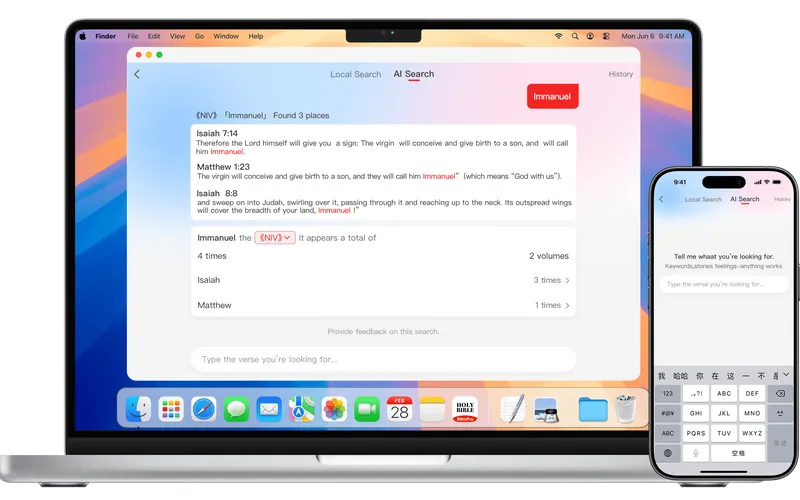
For most of church history, the deep tools of Bible study—concordances, lexicons, parallel translations, study notes—lived only in thick reference books that few believers owned and fewer knew how to use. Today, an AI assistant can put a version of those tools in your pocket and answer questions in plain language. Used wisely, that is a real gift. Used carelessly, it can quietly replace the slow, prayerful reading that actually changes us.
So let's hold two things together. AI is a useful study helper. It is never your teacher. The Bible itself is "profitable for doctrine, for reproof, for correction, for instruction in righteousness" (2 Timothy 3:16), and it is the Holy Spirit, not a chatbot, who guides us into truth. With that anchor in place, here are five practical ways to study Scripture more deeply with AI.
1. Smart topical search: find every thread on a theme
Sometimes you remember an idea but not the verse. Or you want to trace a theme—like fear, hospitality, or the kingdom of God—across the whole Bible. A good AI tool can act like a fast, flexible concordance that understands meaning, not just exact words. Ask it, "Where does Scripture talk about caring for strangers and foreigners?" and it can gather passages from the Law, the Prophets, and the Gospels that a plain keyword search might miss.
The key discipline is simple: treat the list as a starting map, not the destination. AI can hallucinate references or attach a real verse to the wrong idea. So open each passage in your own Bible and read it in context—who is speaking, to whom, and why. The search helps you find the doors quickly; you still have to walk through each one yourself.
2. Comparing translations to see the text more clearly
No single English translation is perfect, because translation always involves choices. Comparing several can reveal where the underlying text is rich, debated, or hard to render. You might ask AI to lay one verse out in a few different versions and explain why they differ.
Take the famous opening of Psalm 23. The KJV reads:
"The LORD is my shepherd; I shall not want." — Psalm 23:1 (KJV)
The World English Bible renders the same line:
"Yahweh is my shepherd: I shall lack nothing." — Psalm 23:1 (WEB)
Seeing "I shall not want" beside "I shall lack nothing" can deepen your sense of what the verse promises. Ask AI to explain the difference, but verify its claims against the actual translations—and remember that a more formal or more dynamic rendering is a tradeoff, not a verdict on which Bible is "right."
3. Original-language word study, made approachable
The Old Testament was written mostly in Hebrew, the New Testament in Greek. You don't need a seminary degree to benefit from that. AI can help you explore the original word behind an English term—its range of meaning, where else it appears, and the nuance it carries.
A classic example is the English word "love." Where one English word stands, Greek often uses several—such as agape (self-giving love) and philia (the love of friendship). When Jesus questions Peter in John 21, the shifting Greek words add a layer many readers never notice. AI can surface that for you in seconds.
Guardrails for word study
- Beware the root fallacy. A word's history or its parts don't always determine its meaning in a given verse; context does.
- Check the reference. AI can invent a Strong's number or misstate a definition. Cross-check anything load-bearing.
- Stay humble. A single Greek word rarely overturns the plain sense of a passage. Use word study to enrich your reading, not to manufacture clever readings.
4. Generating a reading plan that fits your life
Consistency matters more than intensity. AI is genuinely helpful for building a plan you'll actually keep. Tell it your situation—"I'm new to the Bible and have ten minutes each morning," or "I want to read the Gospels before Easter"—and it can map out daily portions at a realistic pace.
You can ask for themed plans (the life of Christ, the Psalms of lament, the parables) or a steady walk through a whole book. Let the plan serve your reading, and feel free to slow down. A single verse that the Spirit presses into your heart is worth more than a chapter you merely skimmed. As the psalmist prayed:
"Open thou mine eyes, that I may behold wondrous things out of thy law." — Psalm 119:18 (KJV)
No plan, AI-generated or otherwise, can answer that prayer for you. Ask God to open your eyes before you open the app.
5. Asking good questions of the text
The quality of your study often rises and falls with the quality of your questions. AI can be a patient sparring partner here—not to hand you conclusions, but to help you interrogate the passage. Good prompts include: "What questions should I ask to understand this chapter?" or "What is the historical background to this letter?" or "What might I be missing in this parable?"
Use it especially to surface other viewpoints honestly. Ask, "How have Christians understood this verse differently, and what is the strongest case for each reading?" That guards you from leaning only on your first impression. Then bring those questions back to the text itself and to your local church—pastors, teachers, and fellow believers who know you and can pray with you. Scripture commends the Bereans, who "searched the scriptures daily, whether those things were so" (Acts 17:11). Do that with anything AI tells you.
A word of humility before you begin
Every tool in this article is a servant, never a substitute. AI does not pray. It does not know God. It cannot convict your conscience, comfort you in grief, or make the words come alive—only the Holy Spirit does that, working through the living word and the gathered church.
So let AI carry the lexicon and lay out the parallels while you do the real work: reading slowly, praying honestly, obeying what you find, and testing every answer against Scripture. The God who gave us his word still speaks through it. Use the new tools gladly, but keep your eyes—and your heart—fixed on the Author.
Carry deeper Bible study in your pocket
BiblePro brings AI-powered search, parallel translations, original-language tools and reading plans together — free to download, so you can study deeply anytime, anywhere.