
Walk into any conversation about the Bible and someone will eventually ask the question that quietly worries a lot of believers: "Which translation should I actually read?" It can feel like a test you might fail. The good news is that there is no single right answer, and most of the popular English translations are faithful, careful work done by scholars who love the Scriptures. The differences between them are real, but they are differences of approach, not of trustworthiness.
Once you understand the spectrum these translations sit on, choosing becomes much less intimidating. You can pick the Bible that fits what you are trying to do right now, and even let two translations work together to give you a clearer view of the text.
The Spectrum: Word-for-Word vs. Thought-for-Thought
Every translation has to answer one basic question: should it follow the original Hebrew and Greek words as closely as possible, or should it focus on carrying the original meaning into natural English? These two goals pull in opposite directions, and most translations land somewhere along a spectrum between them.
On one end is word-for-word translation (sometimes called "formal equivalence"). It tries to mirror the original wording and sentence structure. This keeps you close to how the text was written, though the English can sound more formal or old-fashioned.
On the other end is thought-for-thought translation ("dynamic" or "functional equivalence"). It asks, "What did this mean, and how would we say it today?" The result reads smoothly and clearly, though the translators have made more interpretive choices on your behalf.
Where the Familiar Names Fall
- More word-for-word: the King James Version (KJV), the New American Standard Bible (NASB), and the English Standard Version (ESV) stay close to the original wording.
- In the middle: the New International Version (NIV) and the Christian Standard Bible (CSB) aim to balance accuracy with readability.
- More thought-for-thought: the New Living Translation (NLT) prioritizes clear, everyday English.
- Paraphrases go a step further still, retelling the text in very free language. These can be warm and refreshing, but they are best treated as a companion to a translation, not as your main study Bible.
No point on this spectrum is "the holy one." A word-for-word Bible is not more spiritual; a readable one is not less serious. They are simply tuned for different tasks.
Choosing by Purpose, Not by Reputation
The most helpful question is not "Which translation is best?" but "Best for what?" Here is how the spectrum maps onto real reading.
For Careful Study
When you want to examine a passage closely, trace a repeated word, or compare how a phrase is used across books, a word-for-word translation serves you well. Because it stays near the structure of the original, you can see connections the translators preserved. Paul's tightly argued letters, where one clause builds on the last, reward this kind of slow, attentive reading.
For Devotional Reading
When your goal is to sit with God's Word, pray through a Psalm, or read a chapter before bed, a smooth, readable translation keeps you from stumbling over awkward phrasing. The point of devotional reading is to meet the Lord, not to parse grammar. A clear text lets the words do their work on your heart.
"Thy word is a lamp unto my feet, and a light unto my path." — Psalm 119:105 (KJV)
For First-Time Readers
If you are opening the Bible for the first time, or handing one to a friend who is curious about faith, start with a readable, thought-for-thought or balanced translation. The beauty of older English is real, but it should not become a wall between a new reader and the message. A clear translation invites people in, and they can always grow into more formal versions later.
The Quiet Power of Reading Two Side by Side
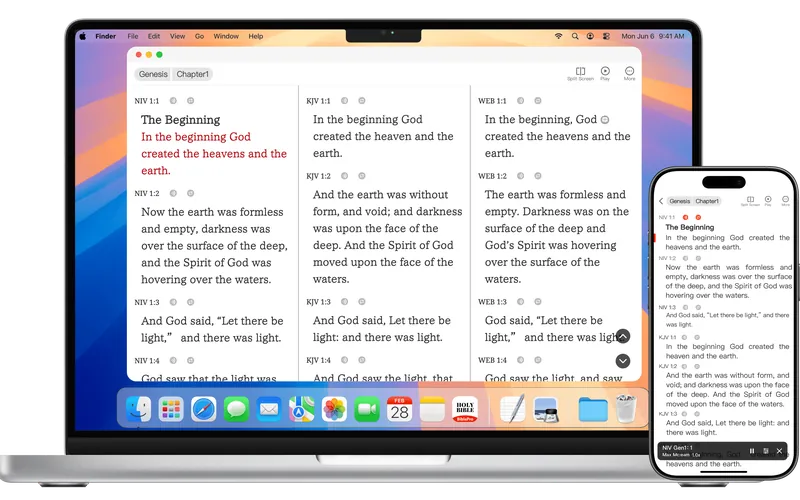
Here is a practice that helps more than almost any other: read a passage in two translations at once, one nearer the word-for-word end and one nearer the thought-for-thought end. Where they agree, you can read with confidence. Where they differ, you have found a place worth slowing down to think about.
Consider how the KJV renders Jesus' invitation:
"Come unto me, all ye that labour and are heavy laden, and I will give you rest." — Matthew 11:28 (KJV)
The World English Bible, a modern public-domain translation, carries the same verse in plainer English:
"Come to me, all you who labor and are heavily burdened, and I will give you rest." — Matthew 11:28 (WEB)
Neither is "the correct one." Reading them together, you feel both the dignity of the older wording and the directness of the newer one, and the meaning stands out more sharply than either could give you alone. Doing this across a whole chapter often surfaces the exact phrases worth studying further.
A Word About Study Helpers
Commentaries, study notes, and AI study tools can all be genuinely useful for surfacing background, cross-references, and questions you might not have thought to ask. But hold them in their proper place. They are helpers, never the authority. AI in particular can be confidently wrong, so anything it tells you should be tested against the Scripture itself, the wisdom of the church, and the work of the Holy Spirit, who alone opens our understanding. The text is the master; the tools are servants.
So, Which Should You Read?
If you want one practical answer: choose a readable translation as your everyday Bible, keep a more word-for-word version nearby for study, and get comfortable reading them side by side. That simple setup covers devotion, study, and first-time reading all at once.
And remember what every faithful translation is trying to hand you. The wrapping differs; the gift does not.
"The grass withereth, the flower fadeth: but the word of our God shall stand for ever." — Isaiah 40:8 (KJV)
Whichever translation you open, you are holding that enduring Word. The best translation, in the end, is the one you will actually read.
Carry deeper Bible study in your pocket
BiblePro brings AI-powered search, parallel translations, original-language tools and reading plans together — free to download, so you can study deeply anytime, anywhere.