
Many of us have tried to memorize a Bible verse, repeated it a dozen times before bed, and forgotten it within a week. The problem usually isn't a bad memory. It's a bad method. Rote repetition treats Scripture like a phone number to cram, when it is actually living truth meant to dwell in us.
The psalmist gives us both the goal and the reason for memorizing Scripture in one short line:
"Thy word have I hid in mine heart, that I might not sin against thee." — Psalm 119:11 (KJV)
Notice the destination: not the head, but the heart. We hide God's word inside us so it can shape how we live when no Bible is open in front of us. Here is a practical, repeatable way to get verses there and keep them.
Understand the meaning before you memorize a single word
Your mind holds on to what it understands far more easily than to random sounds. Before you try to memorize a verse, spend a few minutes learning what it actually says.
- Read the surrounding verses. Who is speaking, and to whom? A promise made to Israel, a command to the church, and a line of poetry are not memorized or applied the same way.
- Find the logical joints. Words like "therefore," "but," "for," and "that" show how the verse moves from one idea to the next. Memorizing the logic is easier than memorizing the words.
- Put it in your own words first. If you can paraphrase a verse accurately, you understand it. Only then go back to memorize the exact wording.
When the meaning is clear, the words have something to stick to.
Break the verse into chunks
Long verses overwhelm us because we try to swallow them whole. Instead, break a verse into two-to-five-word phrases and learn them one at a time, adding the next phrase only once the previous ones flow.
Take a familiar verse and feel the natural pauses:
"For God so loved the world, that he gave his only begotten Son, that whosoever believeth in him should not perish, but have everlasting life." — John 3:16 (KJV)
That is really four small phrases: "For God so loved the world," then "that he gave his only begotten Son," then "that whosoever believeth in him should not perish," then "but have everlasting life." Master the first, then the first two together, then the first three, and so on. This "stacking" method is how musicians learn long pieces, and it works just as well on Scripture.
Use spaced repetition, not cramming
Our brains keep what we revisit at increasing intervals and discard what we touch only once. This is called spaced repetition, and it is the single biggest upgrade most people can make to their memorization.
Instead of reviewing a new verse twenty times today and never again, review it on a schedule that stretches out as the verse gets stronger:
- Today (the day you learn it)
- Tomorrow
- Three days later
- One week later
- Two weeks, then once a month
Each time you successfully recall a verse, you can wait longer before the next review. Verses that slip get moved back to a tighter schedule. A simple stack of index cards works beautifully for this, and a verse-review tool can automate the timing so you only see a verse on the day you actually need to refresh it. If you use any app or AI helper to quiz you, treat it as a helper only, and always check what it shows you against the open Bible itself.
Write it out by hand
Writing engages your mind differently than reading or speaking. The slower pace forces you to attend to every word, and the physical act builds another pathway to the same memory.
- Copy the verse two or three times when you first learn it, saying each phrase aloud as you write.
- Try the "first letter" method. Write only the first letter of each word: "F G s l t w, t h g h o b S..." Then practice reciting the full verse using just those letters as prompts. It is a surprisingly strong test of true recall.
- Keep a memory notebook. One verse per page, with the reference, the date, and a sentence on what it means to you.
Pray the verse back to God
Memorization is not merely a mental exercise; it is part of how we commune with God. When you turn a verse into a prayer, you move it from your short-term memory into the rhythm of your relationship with him.
Take a verse and speak it back personally. From Psalm 119:11, you might pray, "Lord, help me hide your word in my heart today, that I might not sin against you." Praying Scripture does three things at once: it teaches you the verse, it shapes your desires by God's own words, and it invites the Holy Spirit, who Jesus said would bring his words to our remembrance (John 14:26), to do the deep work that no technique can.
Build a daily review habit
The difference between people who know a handful of verses and people whose lives are saturated with Scripture is almost never talent. It is a small, daily habit kept over years.
- Anchor review to something you already do. Recite your current verses during your morning coffee, your commute, or while doing dishes. No extra time required.
- Keep the daily list short. Five minutes of review on the right verses beats an hour once a month. Quality of recall matters more than quantity attempted.
- Start with one verse a week. That is fifty-two verses a year, hidden in your heart, ready when temptation, doubt, or a chance to encourage someone arrives.
This is exactly the pattern the blessed person of Psalm 1 lives by, the one whose "delight is in the law of the LORD; and in his law doth he meditate day and night" (Psalm 1:2). Meditation, in the biblical sense, is simply review with our heart engaged: turning a verse over, again and again, until it becomes part of how we think.
Begin with one verse this week. Understand it, break it into chunks, review it on a stretching schedule, write it out, and pray it back. Then watch how God uses his own word, now hidden in your heart, in the ordinary moments of your day.
Carry deeper Bible study in your pocket
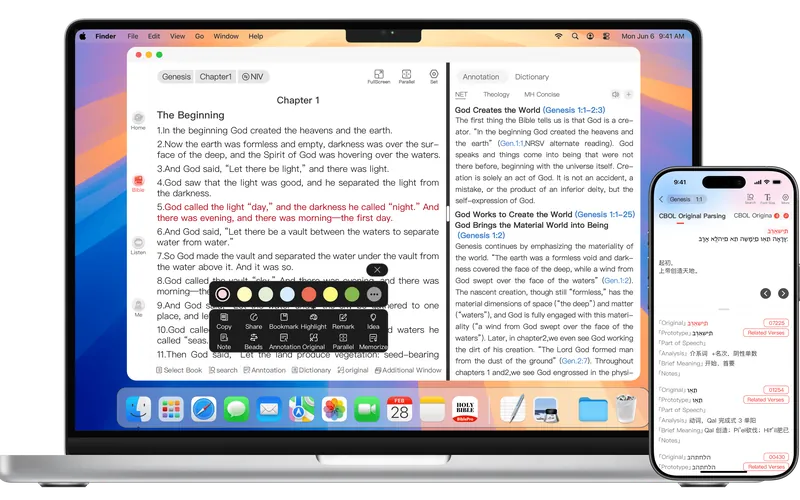
BiblePro brings AI-powered search, parallel translations, original-language tools and reading plans together — free to download, so you can study deeply anytime, anywhere.