
The book of Psalms is the prayer book of the Bible. For three thousand years, people have come to these 150 songs in their joy and their grief, on their best days and their worst, and found words for things they could not say on their own. The Psalms do not pretend life is tidy. They shout, they weep, they wonder, they celebrate. That is exactly why they are so easy to love and, at first, a little hard to navigate.
The good news is that the Psalms are not random. Once you can recognize a few common types, each one starts to make sense, and you know how to read it. This guide walks through the main kinds of psalms, how to approach each, a gentle starter order if you are new, and a simple way to turn any psalm into your own prayer.
Why the Psalms feel different from the rest of the Bible
Most of the Bible is God speaking to us. The Psalms are mostly us speaking to God. They are poetry, not narrative or instruction, so they work by image and feeling more than by argument. Hebrew poetry rarely rhymes sounds; instead it rhymes ideas, often saying something once and then again a slightly different way. When you notice that pattern, you read more slowly and let each line land twice.
Because they are prayers, the Psalms are honest to the point of being uncomfortable. They praise loudly and they complain bitterly, sometimes in the same breath. Reading them well means letting them be what they are rather than smoothing them out.
The main types of psalms
Praise (hymns)
Praise psalms simply adore God for who He is and what He has made. They are full of "praise the LORD" and reasons why. Psalms 8, 103, 145, and 150 are good examples. Read these out loud if you can; they are meant to be sung, and the last verse of the whole book is essentially an invitation to join in.
"Let every thing that hath breath praise the LORD. Praise ye the LORD." — Psalm 150:6 (KJV)
How to read them: Look for the reasons given for praise, and make those reasons your own. Don't rush to application; let the psalm lift your eyes off yourself for a few minutes.
Lament
Laments are the most common type in the whole book, and many believers are surprised by that. A lament is an honest cry to God in trouble: pain, injustice, loneliness, even feeling abandoned by God. Most laments follow a quiet arc, moving from raw complaint toward renewed trust, often turning on a small word like "but." Psalm 13 is short and shows the whole pattern.
"How long wilt thou forget me, O LORD? for ever? how long wilt thou hide thy face from me?" — Psalm 13:1 (KJV)
"But I have trusted in thy mercy; my heart shall rejoice in thy salvation." — Psalm 13:5 (KJV)
How to read them: Let the honesty give you permission to be honest too. Notice the turn toward trust, but don't force it; some laments resolve slowly, and that is part of their gift. Psalms 22, 42, and 88 are worth knowing here.
Thanksgiving
Where a lament cries out before rescue, a thanksgiving psalm looks back after it. The trouble is over, and the writer tells the story of what God did. Psalms 30, 116, and 138 are clear examples.
How to read them: Pause to remember your own specific answered prayers. Thanksgiving psalms train the memory; they teach us to name God's help out loud instead of quietly moving on.
Wisdom
Wisdom psalms step back and reflect on how life works under God, often contrasting two paths. They share the reflective tone of Proverbs. Psalm 1 opens the whole book this way, and Psalm 119 is a long meditation on loving God's word.
"Blessed is the man that walketh not in the counsel of the ungodly, nor standeth in the way of sinners, nor sitteth in the seat of the scornful." — Psalm 1:1 (KJV)
How to read them: Read for the choice they set before you, and ask honestly which path your daily habits are actually taking.
Royal and messianic
Royal psalms were written about Israel's king. Read in light of the whole Bible, many of them point beyond any earthly king to Christ, which is why the New Testament quotes them so often. Psalms 2, 72, and 110 are key ones; Psalm 22 describes suffering that the Gospels connect to the cross.
How to read them: Ask how the psalm describes God's chosen king, then read it with Jesus in view. These psalms are a bridge between the Old and New Testaments.
A starter order for beginners
You do not have to read Psalms 1 to 150 in order. If you are just beginning, try this short path first, spending a few days with each:
- Psalm 23 — the most beloved psalm; quiet trust in God as shepherd.
- Psalm 1 — the two ways, a frame for the whole book.
- Psalm 100 — a brief, joyful call to thanksgiving.
- Psalm 13 — a short lament, complaint turning to trust.
- Psalm 103 — a rich psalm of praise for God's mercy.
- Psalm 51 — a prayer of repentance and a fresh start.
- Psalm 121 — a song of confidence for travelers and the weary.
After that, many readers settle into one psalm a day, or follow the old practice of reading five psalms each day to move through all 150 in a month.
How to turn a psalm into your own prayer
This is where the Psalms become more than reading. Because they are already prayers, you can pray them back to God almost word for word. Try this simple method with any psalm:
- Read it slowly, twice. The first time for the whole, the second time noticing the line that stands out to you.
- Name the type. Praise, lament, thanksgiving, wisdom, or royal? That tells you what the psalm is doing and what it invites from you.
- Pray it line by line. Read a line, then pause and say it back to God in your own words, putting your name and your situation into it.
- Let it stretch you. If a psalm rejoices and you feel flat, pray it as an offering anyway. If it laments and your life is calm, pray it for someone who is suffering.
- End with one sentence. Carry a single line into your day. From Psalm 42:
"As the hart panteth after the water brooks, so panteth my soul after thee, O God." — Psalm 42:1 (KJV)
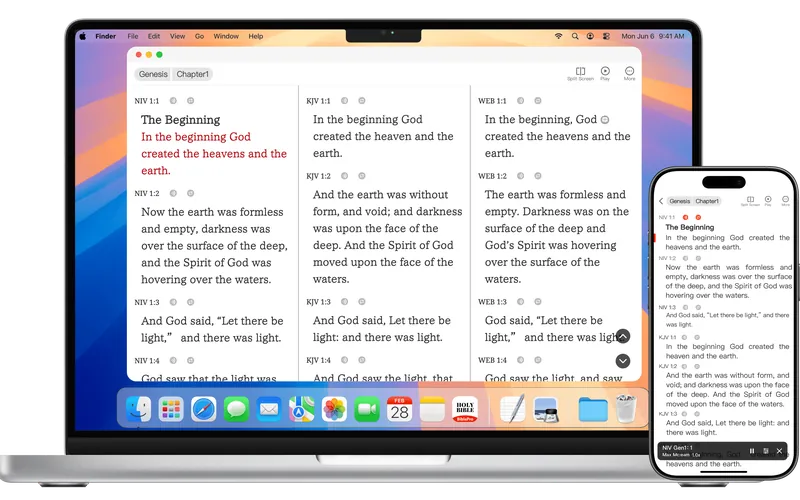
Whatever Bible translation you read from day to day, the Psalms reward slow, repeated reading. Keeping a few notes on the psalm you are praying through, or comparing a wording when something puzzles you, can deepen the habit. Tools can help with that, but they remain only helpers; everything they offer should be weighed against Scripture itself, and they can never replace the Bible, the church, or the quiet work of the Holy Spirit in prayer. Begin with one psalm today, pray it back, and let these ancient songs slowly become your own.
Carry deeper Bible study in your pocket
BiblePro brings AI-powered search, parallel translations, original-language tools and reading plans together — free to download, so you can study deeply anytime, anywhere.