
If you have ever opened a Bible at page one, read a few chapters of Genesis, hit the genealogies and the building instructions, and quietly given up, you are not alone. The Bible is not one book but a library of sixty-six, written over centuries in several styles. Reading it straight through from the first page is one of the most common ways beginners get stuck and stop.
The good news is that you do not have to read it in order, and you certainly do not have to start at Leviticus. There is a gentler on-ramp. Below is a recommended order for a complete beginner, a simple seven-day plan to get your first week under your belt, and honest help for the moment when you read something and have no idea what it means.
Start with a Gospel, not Genesis
The center of the whole Bible is Jesus, so the wisest place to begin is one of the four Gospels — the eyewitness-shaped accounts of his life, teaching, death, and resurrection. They are written to introduce him to you. John even says so plainly:
"But these are written, that ye might believe that Jesus is the Christ, the Son of God; and that believing ye might have life through his name." — John 20:31 (KJV)
Two good first books:
- The Gospel of Mark — the shortest and fastest. It moves at a sprint and gives you the whole arc of Jesus' ministry in about an hour and a half of reading.
- The Gospel of John — slower and more reflective, full of well-known sayings ("I am the bread of life," "I am the good shepherd"). It is warm and quotable and a wonderful place to meet Jesus.
Pick one. You do not need both before moving on.
A simple order for the first few months
Once a Gospel has given you the heart of the story, this order fills in the rest without overwhelming you:
- 1. A Gospel (Mark or John) — meet Jesus first.
- 2. Genesis — now go back to the beginning. Creation, the fall, Abraham, Joseph. This is the foundation everything else builds on, and it reads like a story.
- 3. The Psalms — 150 honest songs and prayers covering joy, fear, anger, grief, and praise. You do not read these straight through; dip in. One psalm a day is plenty.
- 4. The Acts of the Apostles — what happened after Jesus rose: the birth and spread of the early church. It reads like a sequel to the Gospels.
- 5. A short letter, such as Philippians or 1 John — these show you how the first Christians actually lived and what they believed.
- 6. Proverbs — short, practical wisdom you can read one chapter at a time (there are 31, one for most days of the month).
Save Leviticus, Numbers, and the longer prophets for later. They are not unimportant — they are simply far easier to appreciate once you know the bigger story they belong to.
Your first-week 7-day plan
Keep it small enough that you will actually do it. Aim for ten quiet minutes a day. This week walks through the Gospel of Mark in manageable pieces:
- Day 1 — Mark 1: John the Baptist, Jesus' baptism, and the first disciples.
- Day 2 — Mark 2: Jesus heals and forgives; the religious leaders begin to object.
- Day 3 — Mark 4: The parable of the sower and the calming of the storm.
- Day 4 — Mark 6: Feeding the five thousand; Jesus walks on the water.
- Day 5 — Mark 8: "But whom say ye that I am?" — the turning point of the book.
- Day 6 — Mark 10: Teaching on wealth, service, and a blind man healed.
- Day 7 — Mark 15–16: The crucifixion and the empty tomb.
After each reading, ask three simple questions: What does this show me about God or Jesus? What does it show me about people? Is there anything for me to do or pray about today? Write a sentence or two if it helps. That is real Bible study — you do not need anything fancier to start.
What to do when you don't understand a passage
You will hit verses that confuse you. Everyone does. Even in the Bible itself, when the Ethiopian official was reading the prophet Isaiah, he was asked whether he understood it:
"And he said, How can I, except some man should guide me?" — Acts 8:31 (KJV)
Confusion is normal, and there is no shame in needing a guide. Here is what to do:
- Keep reading. Many hard verses become clear from the verses around them. Do not stall on a single phrase; finish the paragraph or chapter and the meaning often settles.
- Read the surrounding context. Who is speaking, to whom, and about what? A line that seems strange alone usually makes sense once you see the scene it sits in.
- Compare a second, more modern translation. The King James Version is beautiful but uses older English. Reading the same passage in a plain-language translation alongside it can unlock a verse instantly.
- Mark it and move on. Jot the reference in a note titled "questions." Often a passage three weeks from now answers it for you.
- Ask a real person. A pastor, a small group, or a trusted Christian friend can help in ways a book cannot. The Bible was always meant to be read in community, not only alone.
Study notes, commentaries, and AI tools can genuinely help you understand background, words, and cross-references. Treat them as helpers, not the final word: test everything they tell you against Scripture itself, and lean on God's Spirit and your church rather than any tool to do the deepest teaching. A helper points you back to the text; it never replaces it.
One last encouragement
Do not aim to read fast or to read a lot. Aim to keep showing up. A few honest minutes most days will carry you further in a year than a heroic burst that fizzles by February. The Bible itself describes how it works — not as a flood of information but as steady light for the next step:
"Thy word is a lamp unto my feet, and a light unto my path." — Psalm 119:105 (KJV)
A lamp shows you the next step, not the whole road. Open to Mark or John tomorrow, read a little, ask your three questions, and let the light come one step at a time.
Carry deeper Bible study in your pocket
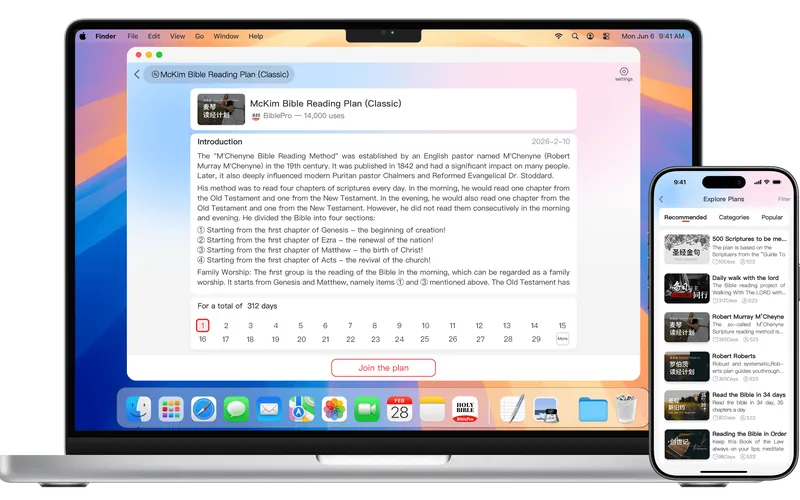
BiblePro brings AI-powered search, parallel translations, original-language tools and reading plans together — free to download, so you can study deeply anytime, anywhere.