
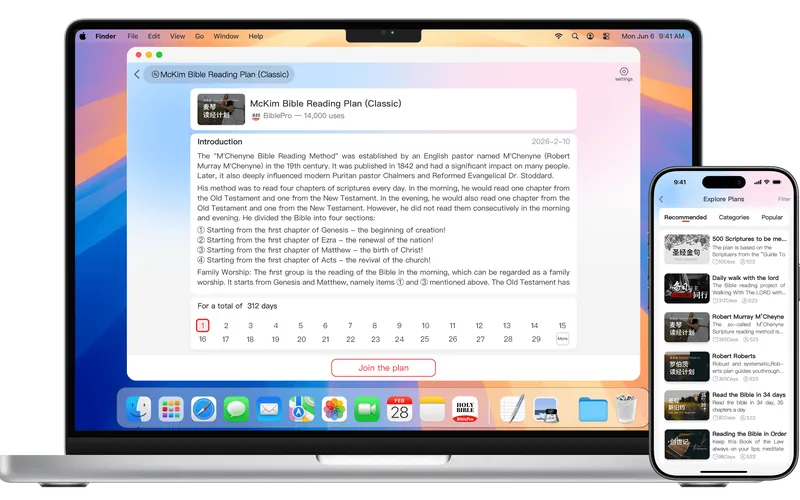
Every January, thousands of believers open to Genesis 1 with real hope, then quietly give up somewhere around the genealogies of Numbers. If that has been your story once or five times, you are in good company, and you are not a failure. Reading the whole Bible in a year is a wonderful goal, but it is a marathon, and most people stall not because they lack faith but because they pace it like a sprint.
This is a practical guide to actually crossing the finish line: how much to read a day, which plan styles fit which kind of reader, what to do when you fall a week behind, and how to keep grace bigger than guilt the whole way through.
The honest math of a year
The Bible is roughly 1,189 chapters. Spread across 365 days, that is a little over three chapters a day, which for most people is fifteen to twenty minutes of unhurried reading. That number is worth sitting with, because it reframes the task. You are not facing an impossible mountain. You are building a short, daily, repeatable habit.
Two adjustments make that math forgiving instead of crushing:
- Aim for 5 days a week, not 7. Build in two natural margin days. Now a missed Tuesday is simply Saturday's reading, not a debt.
- Anchor it to something you already do. Coffee, the commute, the moment before bed. A habit attached to an existing rhythm survives; a habit floating in "whenever I get to it" usually does not.
Pick a plan style that fits how you're wired
Most people quit a plan that fights their temperament. There is no holiest format, so choose honestly.
Genesis-to-Revelation (cover to cover)
Simple and complete: you read straight through. The risk is the long stretches of Old Testament law and history in late winter. It is great for finishers who like order and dislike jumping around.
Chronological
Events are arranged roughly in the order they happened, so Job sits near Genesis and the prophets interleave with the kings. This is wonderful for understanding the storyline, though some chronological plans still bunch the heavy material together.
Old and New Testament daily mix
You read a portion from each Testament every day. The Gospels and epistles keep your heart fed while you work through tougher Old Testament ground. For many beginners, this is the most sustainable rhythm.
Five-day or weekday plans
These build the catch-up margin directly into the design. If you know your life is full, start here rather than setting yourself up to feel behind by week two.
When you fall behind (because you will)
Falling behind is not the exception; it is part of the journey for nearly everyone. The danger is not the gap itself but the lie that whispers, "You blew it, you might as well quit." Resist that voice with a plan.
- Never try to read ten days at once. Cramming turns devotion into a chore and almost always backfires.
- Pick up today, not where you stopped. Read today's date and keep moving. You can circle back to the missed days later, or simply let them go. Finishing in fourteen months still means you read the whole Bible.
- Use your margin days to close the gap slowly. One extra reading on a calm Saturday beats a guilt-driven binge.
The goal was never a perfect calendar. The goal is a heart shaped by the whole counsel of God.
Surviving the hard books
Leviticus, Numbers, the long prophets, the dense middle of Ezekiel: these are where plans go to die. A few things help.
- Read for the big picture, not mastery. On a first pass through Leviticus you do not need to grasp every sacrifice. Notice the themes: holiness, atonement, a God who makes a way to dwell with His people.
- Keep one anchor question. "What does this show me about God, and about my need for Him?" That question turns even genealogies into something to ponder.
- Listen as well as read. Audio carries you through difficult passages on tired days when your eyes glaze over.
- Let a trusted study note or a humble study helper unstick you when a passage is genuinely confusing. Tools, including AI helpers, can offer background and cross-references, but they are servants of your reading, never substitutes for it. Test everything against the text itself, weigh it with your church, and trust the Holy Spirit, who was given to lead us into truth.
Grace over guilt, every single day
Here is the heart of it. The point of a reading plan is not to impress God or to earn a gold star. He already loves you completely. Reading Scripture is how we sit at His feet and let Him form us, and that work is fueled by grace from start to finish.
"They are new every morning: great is thy faithfulness." — Lamentations 3:23 (KJV)
His mercies are new every morning, which means a missed week never resets your standing with Him. You can begin again at breakfast. Steady faithfulness, the kind that keeps showing up, is what God honors.
"And let us not be weary in well doing: for in due season we shall reap, if we faint not." — Galatians 6:9 (KJV)
Don't despise small, ordinary progress either. Three chapters today feels like almost nothing, but small things matter to God.
"For who hath despised the day of small things?" — Zechariah 4:10 (KJV)
And remember why we open the Book at all. It is not for bragging rights but to meditate on God's word and let it dwell in us.
"This book of the law shall not depart out of thy mouth; but thou shalt meditate therein day and night..." — Joshua 1:8 (KJV)
So choose your plan, anchor it to a daily rhythm, give yourself margin, and refuse to quit just because you stumbled. A year from now, you could close the back cover of Revelation having read every word, not because you were perfectly disciplined, but because grace kept carrying you back to the page. Start today. Read a little. Trust Him with the rest.
Carry deeper Bible study in your pocket
BiblePro brings AI-powered search, parallel translations, original-language tools and reading plans together — free to download, so you can study deeply anytime, anywhere.