
If you have ever heard another Christian mention their "quiet time" and felt a little lost, you are not alone. The phrase sounds like an established habit everyone else already understands. In reality, a quiet time is something very simple, and you can begin one today, even if you have never opened a Bible on purpose before.
A quiet time, sometimes called a devotional, is a short, unhurried space you set aside to meet with God by reading a portion of Scripture and praying in response. It is not a performance or a test. It is a relationship habit, the same way a phone call or a shared meal keeps a friendship alive. The goal is not to finish a chapter or to feel a certain way. The goal is to be with God and to let His Word shape you.
Why bother with a daily quiet time?
Jesus Himself withdrew regularly to be alone with the Father. Mark records it plainly:
"And in the morning, rising up a great while before day, he went out, and departed into a solitary place, and there prayed." — Mark 1:35 (KJV)
If the Son of God made deliberate space for quiet and prayer, we have every reason to do the same. Scripture is described as living and nourishing. The psalmist pictures the blessed person as one whose "delight is in the law of the LORD; and in his law doth he meditate day and night" (Psalm 1:2). A quiet time is simply how that delight and meditation get a regular place in an ordinary week.
The simple method: time, place, read, pray
You do not need a system you can barely remember. A reliable quiet time rests on four plain decisions.
1. Choose a fixed time
Pick a time you can actually keep most days, and attach it to something you already do. Many people use the first ten minutes after they wake, before their phone takes over the morning. Others choose a lunch break or the few minutes before bed. The exact hour matters far less than the consistency. A modest habit you keep beats an ambitious one you abandon.
2. Choose a fixed place
Having one spot trains your heart to settle quickly. It might be a particular chair, a corner of the kitchen table, or a bench outside. Keep what you need close by, a Bible and maybe a notebook, so you are not hunting for things when the time comes. The point of the place is not atmosphere but ease, removing small frictions that tempt you to skip.
3. Read and meditate on a short passage
Begin small. A few verses you understand will feed you more than three chapters you rush. Read the passage slowly, then read it again. To meditate simply means to chew on it: turn it over, notice what it says about God, and ask what it means for you. A few honest questions help:
- What does this tell me about God and the way He acts?
- What does it show me about people, including myself?
- Is there a promise to trust, a command to obey, or a warning to heed?
- How should this change my day in some small, concrete way?
4. Pray in response
Let your prayer grow out of what you just read, so it is a conversation rather than a monologue. If the passage shows God's kindness, thank Him for it. If it exposes something in you, confess it. If it gives a promise, ask Him to help you trust it. You do not need polished words; honest, plain speech is welcome. Scripture even invites you to bring your worries to Him:
"Casting all your care upon him; for he careth for you." — 1 Peter 5:7 (KJV)
A first-week plan
To take the guesswork out of where to begin, here is a gentle seven-day path through the Gospel of Mark, which is short, vivid, and full of Jesus in action. Read the listed verses, sit with one or two of the questions above, then pray.
- Day 1: Mark 1:1-13 — How the good news begins.
- Day 2: Mark 1:14-20 — Jesus calls ordinary people to follow Him.
- Day 3: Mark 1:21-34 — His authority over sickness and evil.
- Day 4: Mark 1:35-45 — Jesus prays alone, then heals a leper.
- Day 5: Mark 2:1-12 — Forgiveness and healing for a paralyzed man.
- Day 6: Psalm 23 — A quiet day to rest in the Shepherd's care.
- Day 7: Look back. Reread the verse that struck you most this week and thank God for it.
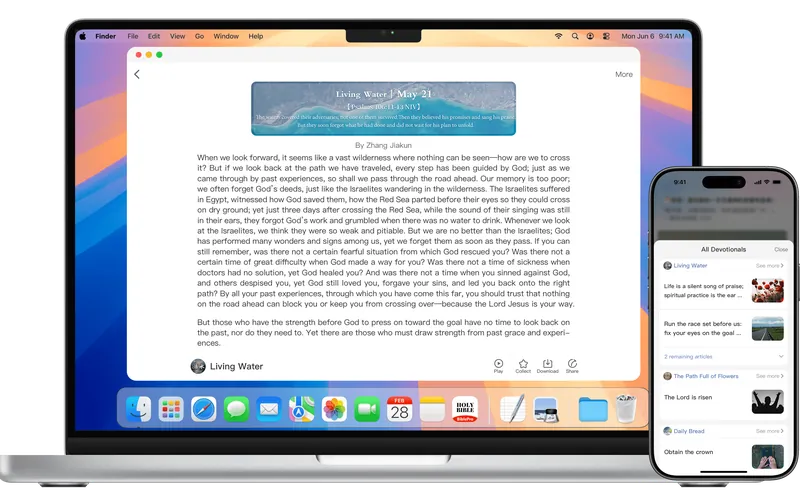
If a tool helps you stay on track, a Bible study app can keep your place, define an unfamiliar word, or surface a cross-reference. Use such helps gladly, but hold them lightly. Any explanation, including anything generated by AI, is only an assistant, never an authority. Test everything against Scripture itself, and remember that real understanding comes through the Holy Spirit and the fellowship of the church, not through any device.
Common questions from beginners
How long should it take?
Start with five to ten minutes. That is genuinely enough to read a short passage, think, and pray. A brief time you keep daily forms a far deeper habit than a long session you dread. As your appetite grows, the minutes will stretch on their own.
What if I miss a day?
You simply begin again the next day, without guilt or self-punishment. A quiet time is not a streak to protect or a rule that condemns you when broken. God's welcome does not depend on a perfect record:
"The LORD is merciful and gracious, slow to anger, and plenteous in mercy." — Psalm 103:8 (KJV)
Missing one morning is not failure. Quietly quitting because you missed one is the only real danger, and the cure is always the same: come back tomorrow.
What if I do not feel anything?
Feelings come and go, and a quiet time is not measured by them. Some of the most fruitful seasons feel ordinary while you are in them. You are showing up to be with God and to be shaped by His Word, and that work happens whether or not your emotions cooperate.
Begin small, begin today
You do not need to feel ready, well-studied, or especially spiritual. You need a few quiet minutes, a short passage, and a willing heart. Choose your time, choose your place, open to Mark 1 tomorrow morning, and talk to God about what you read. Do that for one week, and you will already have a quiet time, simply because you started one.
Carry deeper Bible study in your pocket
BiblePro brings AI-powered search, parallel translations, original-language tools and reading plans together — free to download, so you can study deeply anytime, anywhere.