
When the diagnosis comes, when the marriage ends, when the phone call breaks you in half, the question rises whether we say it aloud or not: Where is God? Some well-meaning people answer too fast. They hand you a verse like a bandage and hurry on. But the Bible itself is far more patient with pain than we often are.
Scripture does not explain suffering away. It does something better. It enters the dark room and sits down with us, and it dares to speak honestly about grief while still holding out hope. If you are hurting right now, this is for you.
The Bible lets us lament
One of the most surprising things about the Bible is how much room it gives to raw, unedited grief. Roughly a third of the Psalms are laments. The book of Job spends more than thirty chapters letting a suffering man pour out his complaint, and God never rebukes him for being honest. Job's friends offered tidy theology; Job offered his wounds. In the end, God sided with the honest sufferer, not the tidy explainers (Job 42:7).
The book of Lamentations is an entire scroll of weeping over a ruined city. And yet, right in the middle of that grief, the writer reaches for something to stand on:
"It is of the LORD's mercies that we are not consumed, because his compassions fail not. They are new every morning: great is thy faithfulness." — Lamentations 3:22-23 (KJV)
Notice the order. Lament comes first, and hope is spoken from inside the grief, not instead of it. You are allowed to tell God the truth about how much this hurts. He can handle your honesty. In fact, He invites it.
God is near to the broken, not far
It can feel, in pain, as though God has withdrawn to a safe distance. The Bible says the opposite is true:
"The LORD is nigh unto them that are of a broken heart; and saveth such as be of a contrite spirit." — Psalm 34:18 (KJV)
This is not a verse about God preferring strong, cheerful people. It is the reverse. Brokenness is precisely where He draws near. When you are too weary even to pray with words, that emptiness is not a sign of His absence. According to this verse, it is the very address where He shows up.
The cross: God knows suffering from the inside
Christianity makes a claim no other answer to suffering makes. It does not say God watches our pain from a comfortable throne. It says God Himself entered it. At the cross, Jesus was betrayed, abandoned, mocked, and tortured. He cried out the opening line of a lament psalm, "My God, my God, why hast thou forsaken me?" (Matthew 27:46), quoting Psalm 22.
This matters enormously. When you bring your suffering to God, you are not bringing it to a stranger. You are bringing it to Someone who has felt the lash, wept at a grave, and been deserted by His closest friends. Whatever you are facing, He is not detached from it. He has been there.
And the cross was not the end of the story. The resurrection means that suffering and death do not get the final word over those who trust Him.
Hope that does not pretend
Because of the resurrection, the New Testament can speak of present suffering with clear eyes and real hope at the same time:
"For I reckon that the sufferings of this present time are not worthy to be compared with the glory which shall be revealed in us." — Romans 8:18 (KJV)
Paul does not call suffering small. He calls present sufferings real and the coming glory greater still. A few verses later comes a promise often misquoted, so read it carefully:
"And we know that all things work together for good to them that love God, to them who are the called according to his purpose." — Romans 8:28 (KJV)
This verse does not say every event is good. Cancer is not good. Abuse is not good. It says God is able to weave even terrible things toward a good end for those who love Him. That is comfort that respects your pain instead of denying it.
Comfort that becomes a gift to others
The Bible also gives suffering a strange dignity. The comfort God pours into you is not meant to stop with you:
"Blessed be God, even the Father of our Lord Jesus Christ, the Father of mercies, and the God of all comfort; who comforteth us in all our tribulation, that we may be able to comfort them which are in any trouble, by the comfort wherewith we ourselves are comforted of God." — 2 Corinthians 1:3-4 (KJV)
One day, your scars may become the very reason another broken person trusts you. The comfort you receive now is being stored up for someone you have not yet met.
Concrete ways to pray and study in pain
Honest theology is not enough on its own; you need ways to actually meet God when you hurt. Here are a few:
- Pray a lament. Use the pattern the Psalms model: tell God exactly what is wrong, ask Him plainly for help, and end by recalling one thing that is true about Him. You do not have to feel the hope to speak it.
- Pray Scripture back to God. When you have no words, borrow the Bible's. Slowly pray Psalm 13, Psalm 42, or Lamentations 3:19-26 out loud, making the words your own.
- Read whole, not in fragments. Sit with an entire passage rather than a single line. Read all of Job 38-42, or Romans 8 start to finish, and let the bigger story hold you.
- Keep a small record. Write down your honest prayers and, over weeks, note where God met you. Lamentations 3 was written by someone looking back and finding mercy in the ruins.
- Do not grieve alone. The "us" and "we" of these verses are plural. Let one trusted believer or your church carry part of the weight. The Holy Spirit often comforts us through other people.
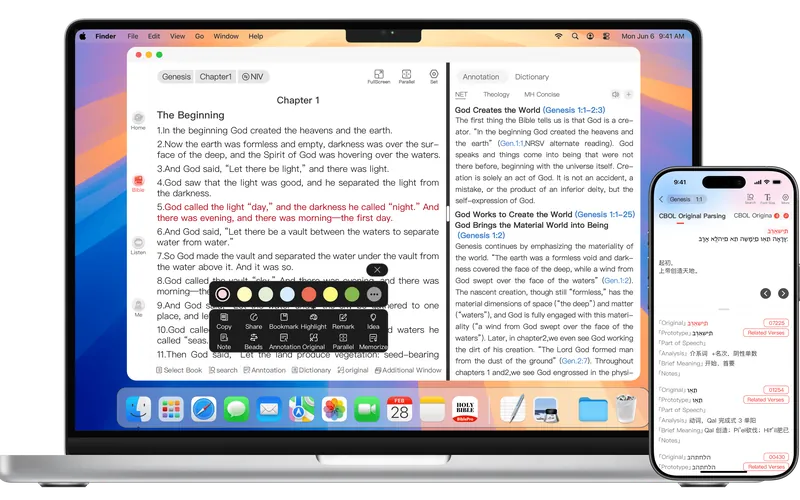
A study app can help you find these passages quickly, sit in them, and learn the context. If you lean on AI tools while studying, treat them only as a helper that points you back to the text. Always weigh what they say against Scripture itself, and never let any tool stand in for the Bible, the church, or the quiet work of the Holy Spirit in your heart.
So, where is God when we suffer?
He is near the broken-hearted. He is the God who wept and bled and rose. He is the One who lets you lament without shame and who promises that present grief is not the end of your story. You may not get every answer you want. But you are not abandoned, and you are not alone. Bring Him your honest pain today, exactly as it is.
Carry deeper Bible study in your pocket
BiblePro brings AI-powered search, parallel translations, original-language tools and reading plans together — free to download, so you can study deeply anytime, anywhere.